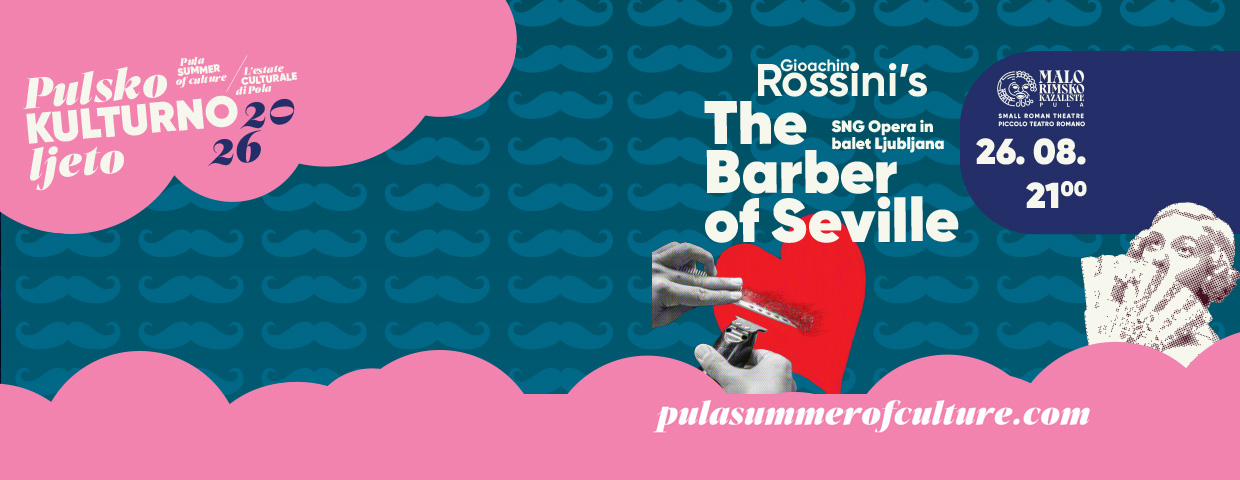
Italian composer Gioachino Rossini (1792–1868) was regarded as the most popular composer of his time during the first half of the 19th century. In Vienna, he even overshadowed Beethoven and Schubert, so it is hardly surprising that numerous anecdotes about him and his work began circulating during his lifetime. He was known as an exceptionally prolific composer who created a large number of what some described as “similar-sounding operas”, while at the same time he was often associated more with his love of French cuisine than with composing. Wagner once famously remarked about his operas: “If you know one, you know them all.”
It is a fact that Rossini composed both remarkably quickly and prolifically. Some of his operas were written in just two to four weeks, which is why he often “borrowed” individual passages or musical numbers from his earlier works. The famous overture to The Barber of Seville was itself originally intended for other operas. Nevertheless, The Barber of Seville (1816) is considered both the pinnacle and the magnificent culmination of opera buffa, once an immensely popular operatic genre.
The opera was written to a libretto based on Pierre-Augustin Caron de Beaumarchais’ famous comedy The Barber of Seville and continues to captivate audiences more than two centuries after its creation. It is also one of the most frequently performed works in the operatic repertoire. Its enduring popularity owes much to its witty music, distinctive and memorable melodies, striking rhythms and characteristically lively ensembles at the ends of the acts. Its solo arias have long been an essential part of the repertoire for basses, coloratura mezzo-sopranos and baritones.
On opera stages around the world, The Barber of Seville continues to inspire new interpretations, ranging from radical and experimental productions to entirely traditional ones. The work remains compelling today thanks to its highly expressive score, which closely follows the unfolding action and relationships between the characters through a series of unexpected twists, creating a powerful connection between the story and its musical narrative.
This production is directed by Krešimir Dolenčić, one of Croatia’s most prominent and versatile directors. Throughout his distinguished career, he has directed more than 50 theatre and opera productions in Croatia, the United States, the United Kingdom, Germany and China. At the Slovenian National Theatre Maribor, he has directed Offenbach’s The Tales of Hoffmann (1992), Puccini’s operatic triptych Il tabarro, Suor Angelica and Gianni Schicchi (1993), Debussy’s Pelléas et Mélisande (1997), as well as Stravinsky’s Oedipus Rex and Carl Orff’s Trionfo di Afrodite (1998).