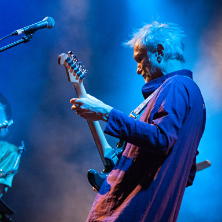
Darko Rundek (born January 30, 1956 in Zagreb, Croatia) is a singer-songwriter, poet, director, and one of the most influential musicians of the former Yugoslavia and the wider Balkan region. His career spans more than four decades, marked by constant artistic exploration, the blending of various genres, and lyrically profound songwriting.
He first made a significant artistic mark as the frontman of the cult new wave band Haustor, formed in the late 1970s. With albums such as Haustor (1981), Treći svijet (1984), and Bolero (1985), the band fused rock, reggae, ska, jazz, and world music, while creating poetic, socially engaged songs like “Moja prva ljubav”, “Ena”, “Bi mog’o da mogu”, and “Šejn”. Rundek’s ability to combine a distinctive vocal delivery with rich musical textures placed Haustor at the very top of the Yugoslav alternative scene.
After the band’s breakup in the early 1990s and his move to Paris, Rundek began a solo career that, with his debut Apokalipso (1997), proved to be bold and innovative. The album received critical acclaim for its combination of Croatian lyrics with multicultural influences, experimental arrangements, and his recognizable poetic style. This was followed by U širokom svijetu (2000), Ruke (2002), and Mhm A-Ha Oh Yeah Da-Da (2006), on which Rundek continued exploring sound while collaborating with musicians from various parts of the world.
In 2003, he formed the collective Rundek Cargo Orkestar, later Rundek Cargo Trio, with which he expanded his music both on tour and in the studio, often moving from intimate acoustic arrangements to rich orchestrations. The album Mostovi (2015) and later projects cemented his status as an artist capable of bridging personal expression with universal messages.
His lyrics often explore themes of love, transience, social change, exile, and identity, using a metaphorical and vivid language. Rundek is also a composer for theatre and film, as well as a director, which is reflected in the strong visual and narrative dimensions of his work.